


On March 19 2026 OpenAI said they are buying Astral, the company that made uv Ruff and ty using Rust. Charlie Marsh and his team will now work with OpenAIs Codex group. They still need to get approval from the government. They did not say how much money they paid. People started talking about this on Hacker News. It got a lot of attention over 750 points and people seemed to be worried and a little upset.
I want to talk about how I felt when I heard this news. I think a lot of people felt the way. At first I was a bit surprised. Felt a little bad. Then I thought about it. Felt silly for feeling that way. These are tools that anyone can use and they are licensed in a way that allows us to do what we want with them. OpenAI cannot just take away uv from my computer. So why was I feeling uneasy about OpenAI acquiring Astral and the tools like uv?
The simple answer is that people are not really worried about the license of uv and other tools. What people are really worried about is the direction that OpenAI will take Astral and the tools, like uv and Ruff and ty.
This is not a product it is a position.
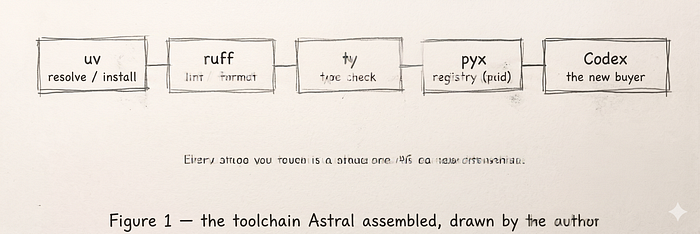
If you write Python code you are likely using Astrals code already even if you did not realize that it all comes from the company. For example uv has replaced the process of using pip, venv, pyenv and pipx with just one fast binary. Ruff has combined the tools for checking and formatting code into one tool. Then there is ty, which's a new tool for checking the types of data in your code.. Pyx is the commercial private registry that was supposed to be the part that makes money.
When you look at all of these tools together you will notice something. Astral does not own one part of the Python workflow. Astral has a tool for every part: figuring out what dependencies you need checking your code for mistakes formatting your code checking the types of data in your code and now the registry layer that is underneath all of these things. OpenAI did not just buy a tool, for managing packages. It bought a place at every stage of how Python code is built.
Read OpenAI's plan. It is pretty clear. The company wants to do more than just create AI that writes code. They want systems that help with the development process. A coding tool that writes, runs, formats and shares Python code is more helpful when it controls the tools that run, format and share the code. Having control over the toolchain means having control over how developers use the tool.
Simon Willison said something, about the talent side. The Codex CLI is a Rust program. Astral has some of the best Rust engineers. Just one of them might be enough to make the acquisition worth it. This makes us wonder is this a purchase of a product or just a way to get engineers? The answer changes how you should think about the tools.
- Is this a product purchase or a talent purchase?
- The answer changes what you should expect from the tools.
Forkable is not the same, as great
The repeated promise goes like this: uv, Ruff and ty are MIT and Apache 2.0 licensed so if OpenAI ever messes them up the community can just fork them and move on. Armin Ronacher, who made Flask said uv is very easy to fork and keep up even if things go bad. Marsh himself said on Discord that he won't let AI ruin his projects and some of his team members agreed.
I trust all of that.. I also think it overlooks how open source projects usually fall apart.
The risk is not a relicensing rug-pull. It is the slow drift where the roadmap quietly starts serving Codex instead of you.
THE POST-ACQUISITION WORRY, IN ONE SENTENCE
A fork can only help you if someone is there to take care of it. The people who can best take care of a fork of uv are now working at OpenAI. The license allows you to take the code. It does not guarantee that the skilled people the energy or the support will come with it.
- We saw something similar happen in the Rust world recently.
- The tool cargo-dist did not find a way to make money.
- Many people relied on it. It lost support.
- A lenient license did not stop this from happening.
- It just meant that the loss of support was allowed by law.
When JetBrains writes in their blog post that these tools will not go backwards I tend to agree.
Going backwards is not what people are worried about.
They are worried, about things going sideways or becoming stagnant.
A uv that keeps releasing versions. but only focuses on what an AI agent needs and not on what a human needs is still technically moving forwards.
The pyx question is the one.
Here is what really bothers me. The worry about Astrals funding is not new. Its not unfair. The team was honest about it from the start.
In September 2025 Marsh shared the plan on Mastodon. He did not want to charge for the open source tools. He did not want the paid offerings to compete with each other. Instead he wanted to build something that works with uv and sell it to companies that already use it. A good example he gave was an enterprise registry.
A year later that example became pyx in beta with Ramp, Intercom and fall as partners. That was a plan. The VC-backed company keeps the tools free. Sells a hosted server product to big companies. Everyones goals stay the same. Astral got seed money from Accel. Later from Andreessen Horowitz.
Dev tools are hard to make money from. So pyx was the answer to the question that really mattered: how does this company survive without hurting the thing I rely on? The acquisition changes that answer.
Nobody knows what happens to pyx now. OpenAI did not buy Astral to run a Python package registry. The future of the one product that was supposed to keep the company going is the unknown in the whole deal. If pyx quietly becomes a Codex feature or disappears the original promise, about goals goes away. That's because the company that made the promise no longer exists on its own.
Mostly nothing and a little something
Let me not wrap this up with a conclusion because I do not have one. I am not getting rid of uv. It has really helped my Python work over the years. The code we have today works well. Is stable. The MIT license is still okay if the person who owns it changes.
What I am doing is low-key. I am not building anything that relies on pyx being in two years. I am keeping my projects so they can use PyPI and pip if I need to. That does not cost me anything now. Gives me options later. I am also keeping an eye on who's checking the code six months from now. If the people answering questions start optimizing for a computer program of a person that means the tool I trusted has changed.
The community already suggested a solution: give uv to the Python Software Foundation make it the official choice and remove any concerns about corporate motives. That did not. Probably will not. So we are left like we usually are, with source, which is trusting people, not institutions and seeing if that trust lasts.
For now Charlie Marsh says he will not slack off. I think he means it. What I keep thinking about is the part nobody can guarantee: what happens when it is no longer his responsibility.